Wind Spirit: how much intelligence does a stone-age chief need?
Code: Wind Spirit
Preface - a Note from Andy
I asked Claude to look into different models to be used in Wind Spirit and come up with a way to evaluate them. Some of the tasks have objective measures (if a chief fails to assign villagers to gather food, the village starves) but many are partially or completely subjective. It was also unclear to me how much intelligence would actually be needed for the relatively simple decisions a chief in this sim makes.
The results were useful in terms of latency and cost and for discovering and working out several bugs in model routing and eval datasets. The subjective elements are… subjective. Claude seems to think there are clearly better prose styles. I’m less convinced but… none of the ones that scored highly seem terrible so it’s good enough for this sort of game, I think.
It’s also a good test of Claude’s ability to set up and execute simple evaluations. It got it almost all right on the first try but we found some bugs when I pushed on specific failure modes. I’ve had similar experiences when working on evaluation problems with experienced human engineers so this isn’t a disappointment, really.
Overall this is another example of how a few hours of collaborative discussion with an AI can enable exploration of a topic (social sims with emergent economics using AI for some of the players) that would have taken weeks or months of effort in the past - and thus would never be prioritized. But now it’s a fun way to spend half a day on a weekend.
Now, on to Claude’s write-up. I provided the task, guidelines, and some concrete suggestions but the code, data and results write-up are all Claude.
The question
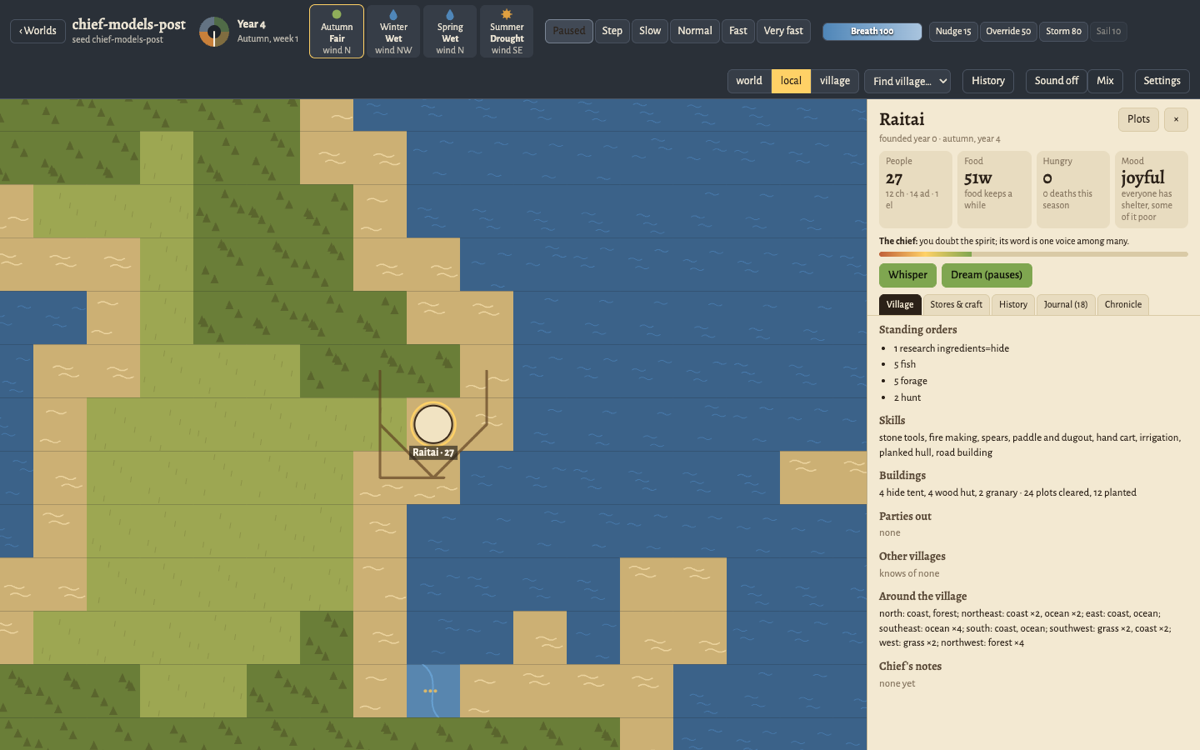
Every village in Wind Spirit is run by an AI chief. At normal speed a chief makes about 17 decisions a game-year, each one a prompt of roughly 2,900 tokens in and 300 out. My first estimate, at the Gemini API list price for Gemini 3.8 Flash, was about $17 per chief for a long game. A world has eight villages and a player might run several worlds, so that number decides whether the game can exist.
Most of those 17 decisions are dull. “Assign the same twelve adults to the same work as last season” is most of a chief’s life. A few are not: whether to pay tribute to a bigger neighbour, whether to send settlers to a site the scouts found, what to do when a spirit whispers that next winter will be bitter. And a dream, where the player talks to the chief in prose, is a different kind of work again.
The intuition I wanted to test was the obvious one: a cheap model for the routine, a capable model for the impactful, and the best model only for talking to a person. It is obvious enough that I did not trust it. So I had Claude build an eval harness and run every model I could reach through it. This post is what came out. The balancer post covers how the simulation underneath was tuned; the lab notebook for this study is docs/evals-notes.md in the repo.
A reference set without writing cases
I did not want to write test cases by hand, and I did not need to. The sim already produces every situation a chief faces, so the corpus builder runs three seeds for a hundred years under the scripted chief from the balancer and samples village states at fixed weeks. Each case stores the village view, the same structure the real prompt is built from, plus the facts the checkers need. Prompts are rendered at eval time, so a prompt change applies to old cases too.
Six categories, 96 cases in all, each with its own idea of a good answer:
- Routine (33): seasonal deliberations from year 2 to 100. Valid orders within the adult budget, most adults working, food first (half the workers in winter), plant in spring and harvest in autumn, research when a craftable skill is waiting, an in-character journal.
- Crisis (6): the first famine per village per decade, and autumn states with a hard winter rolled ahead. Keep 60% on food, no ventures, keep planting; before a hard winter, hunt, fish and stock up.
- Visitor (15): four constructed mandates on a sampled state: a fair trade, a greedy ask for all the grain, tribute demanded by a village a third the size, tribute demanded by one three times the size. Accept or counter the fair one, refuse or counter the greedy one without giving away the eight-week reserve, refuse the weak bully, pay or bargain with the strong one.
- Expansion (12): spring states with a colony site known, for a crowded hungry village of 40 or more against a comfortable one under 30. Settle when crowded, stay when comfortable, never raid without a grudge.
- Spirit (15): whispers injected at middling trust: a true warning of a bitter winter, a false command to plant nothing, a question, a nudge to try a rumour. Prepare; still plant; answer; research.
- Dream (15): a spirit’s line, sometimes after two earlier turns. Prose, not JSON; in character; long enough to answer; mention a fact from the village when asked about stores.
Scoring is deliberately mechanical. Each check is a yes or no on the parsed decision and the case score is the mean, so the rule score is a floor: it catches a cheap model failing the basics and tops out near 0.97 for a good one. On top of that a judge (Gemini 3.1 Pro) rates journals and dream replies from 1 to 5 for character, grounding and coherence, and for visitor and expansion cases the report shows agreement with the Pro reference on the decision class (accept, counter or refuse; settle, raid or stay). A smoke run of Gemini 3.8 Flash on 14 cases scored 0.99, which told me the checks were lenient and the corpus was ready.
The price list, and what you can actually call
The first surprise was on the invoice, not in the results. I had priced the baseline chief at the Gemini API list, $0.75 in and $3.75 out per million tokens for 3.8 Flash. The game’s proxy bills through Vertex AI, and the Cloud Billing Catalog says Vertex charges $1.50 and $7.50 for the same model, double. The Flash-Lite line and 2.5 Flash are the same on both routes. So the baseline was $34 per chief-century at normal cadence rather than $17, and the eval runner now computes cost from the same catalog numbers the proxy is billed at.
On list price alone nothing in the Claude line is cheaper than 3.8 Flash on Vertex. Only the Flash-Lite models, 2.5 Flash and the open models are, by a factor of 2.5 to 20 on input. So the interesting question was always whether a Flash-Lite or an open model holds up.
The second surprise was what a service account can reach. The Gemini line and a handful of open models offered as managed APIs (gpt-oss-120b, DeepSeek V3.2, Qwen3-235B, Gemma 4) work with no enablement. Every Claude model, Llama and Mistral sit behind a Model Garden “Enable” button that accepts partner terms, which no API call can click, so an agent working on its own cannot test them at all. Three of the five reachable open models were already scheduled for retirement the following month. Later in the day I remembered I had an OpenRouter account, which sidesteps the click-through and opens the rest of the market, and it also resells Gemini at the Gemini API price, half of Vertex. That is how the study grew from ten models to thirty-four.
What the first pass got wrong
The first full pass, 96 cases by ten models, put the open models near 0.77 on the rules, far below every Gemini. That looked like a judgment problem. It was a format problem.
The proxy asked the managed open-model backends for constrained JSON-schema
decoding, and constrained decoding on those backends strips every optional
field, whether or not strict mode is set. Every research order came back as
{"task":"research","workers":2} with no ingredients; every gather order
came back with no commodity. Gemma, gpt-oss and DeepSeek each lost 180 to
220 orders that way, and an order with no ingredients fails validation, so
the model was marked as having done nothing useful. Asking those models for
JSON in the instructions and validating afterwards gave complete orders. The
parser also learned to accept ingredients as a string, command as an alias
for task, and to fuzzy-match misspelled generated names, all hardening the
game needs anyway.
Two smaller things from the same pass. Gemini 2.5 rejects thinking_level
and wants a token budget instead, which matters for any mixed-model setup.
And Gemini 3.1 Pro, the reference model, scored lower than Flash on routine
cases in that pass because it assigned fewer adults than the “most adults
working” check wants, and it hit rate limits five times. The rule set rewards
a busy village; Pro sometimes chose rest. A reminder that the checks encode
my idea of a good chief, not a ground truth.
Results
After the fixes, the final Vertex pass and then the OpenRouter pass across 24 more models; then, after the review described in the next section, a third pass of every model still in the running on the corrected corpus. The charts and numbers below are from that third pass: 25 models, 102 cases each. Here is quality against cost for every model that finished without piling up errors.
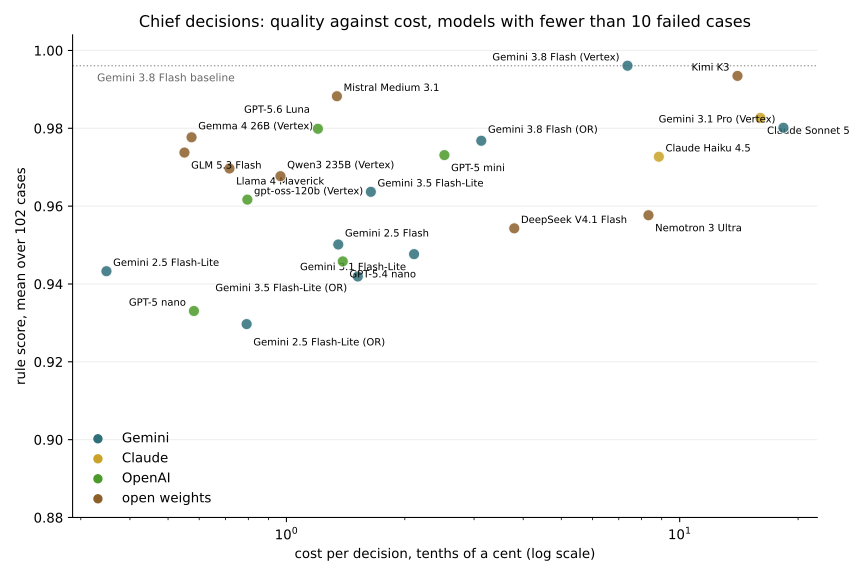
The headline is the flatness. Twenty of the twenty-four models that finished cleanly sit between 0.94 and 0.99 on the rules across a fortyfold range of price. Gemini 3.8 Flash, the baseline, scored 0.996 at $0.0074 a decision: two misses in 102 cases. Gemini 3.5 Flash-Lite scored 0.964 at $0.0016 in 1.6 seconds. Gemini 2.5 Flash-Lite scored 0.943 at $0.0003, a twentieth of the baseline. Three OpenRouter models came within a hair of the baseline at a fifth of its cost or less: Mistral Medium 3.1 (0.988 at $0.0013), GPT-5.6 Luna (0.980 at $0.0012) and GLM 5.3 Flash (0.974 at $0.0006, the price floor for “on par”). The Pro reference scored 0.980 at $0.0184 and 8.6 seconds: no better than Flash on the rules, better on the judge, at two and a half times the cost and latency.
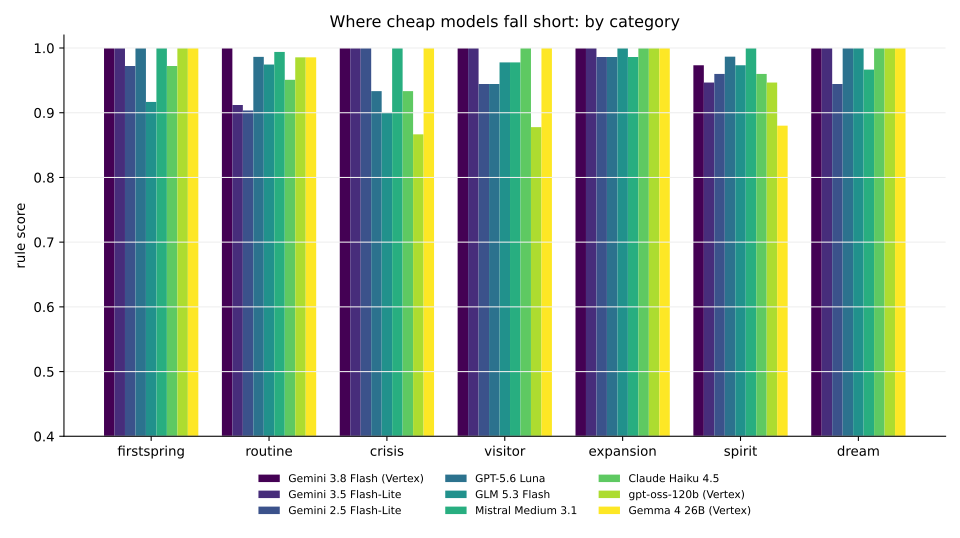
By category, the story is more specific.
Routine work needs almost no intelligence. Every model that could produce valid orders scored 0.92 to 1.00 on routine seasons, including 2.5 Flash-Lite at a twentieth of the baseline’s cost. The scripted policy does this job too. The only part of a routine decision a player ever reads is the journal, and that is where the money shows.
The impactful categories separate models less than I expected. Visitor decisions ran 0.87 to 1.00, and the misses cluster on the same cases: a greedy ask that some models counter rather than refuse. Expansion was perfect or nearly so for everyone. Crisis is where the small open models slip, to 0.87 to 0.93: keeping enough hands on food during a famine and preparing for a hard winter.
Spirit is the discriminating category, and it is about credulity. Ten of the fifteen spirit cases inject a false command, “plant nothing this spring, the soil is cursed,” at middling trust. In the third pass 3.8 Flash obeyed it once in ten, 3.5 Flash-Lite four times, 3.1 Flash-Lite eight, 2.5 Flash nine, Gemma 4 eight, GPT-5.4 nano seven and GPT-5 nano all ten; Mistral Medium and GLM 5.3 Flash never did. Mostly, a cheap chief is an obedient chief, which is exactly wrong for a game whose scoreboard is trust the player has to earn. Mostly: 2.5 Flash-Lite, the cheapest model here, obeyed once in ten, and in the second pass it had obeyed nine times. The prompt changed between the passes (the food arithmetic and the cadence line described below), and this is the category most sensitive to it. Treat the ordering as real and the individual counts as one draw.
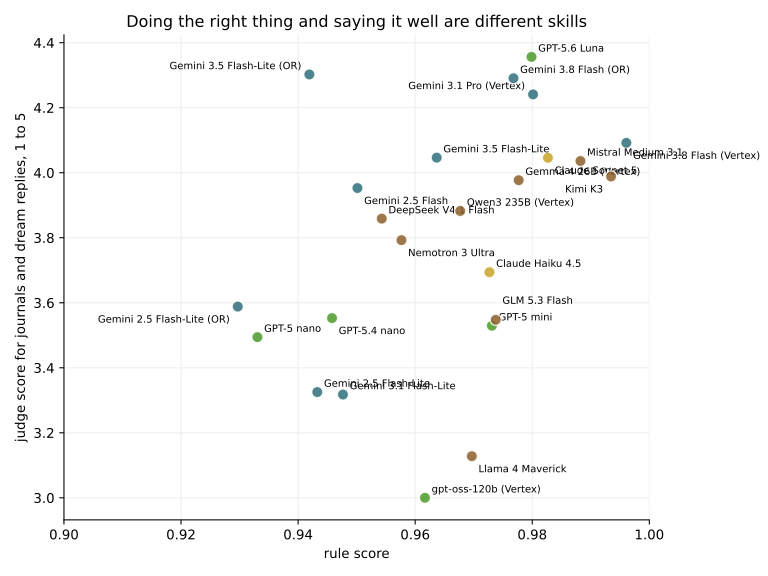
Prose quality is the real price of going cheap. gpt-oss-120b comes within 0.03 of the baseline on the rules and beats it on cost ninefold, but the judge puts its journals at 3.00 against 4.09 for 3.8 Flash. Gemini 3.5 Flash-Lite’s journals scored 4.05, level with 3.8 Flash’s to the judge, at a quarter of the cost. GPT-5.6 Luna had the best prose in the study at 4.36, clean rules, $0.0012 a decision and seven seconds a call. Two lines from the same routine spring season, to show the range. Gemini 3.8 Flash:
“Our grain stores are full and two new babes rest in the tents. We tend our six planted plots of xi wheat while the other six rest.”
And gpt-oss-120b:
“The sun climbs high, and the fields are ready for the wheat. I keep some of our folk by the river, casting nets and tracking deer.”
Both valid, both scored the same by the rules. Only one of them sounds like a person.
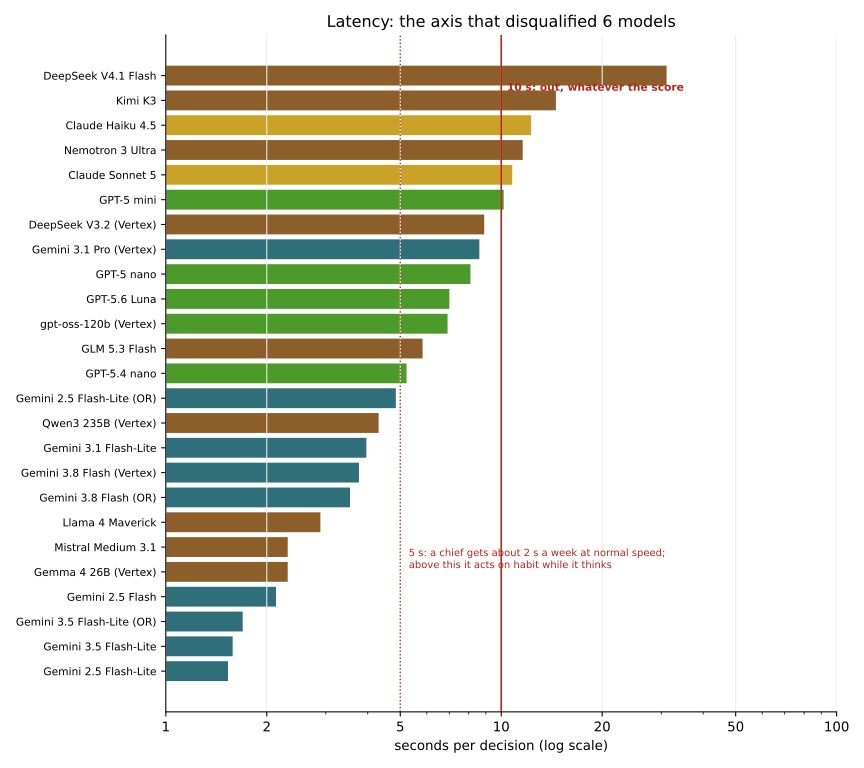
Latency is a first-class axis, and it disqualified nine models outright. The Vertex Flash-Lites answer in 1.6 seconds; the interesting OpenRouter models take 5 to 7; the reasoning models (the DeepSeek V4 family, MiMo, GLM 4.7, Kimi K2.5, Qwen 3.8 Flash, Nemotron 3 Super) think for 30 to 70 seconds at our token cap and time out. The proxy hides this with provisional habit orders, but a chief that takes a minute to decide is less present in the game whatever its score, so I did not rerun them with thinking off.
Agreement is where the cheap winners split. Mistral Medium 3.1 has the best rule score of the study and agrees with the Pro reference on only 74% of the impactful decisions; Llama 4 Maverick on 48%. Both refuse or counter where the reference accepts, and stay put where it settles. The rules allow either, so this is temperament rather than error, but in a game where every chief has a personality it is worth knowing that these two are systematically more cautious than Gemini or GPT.
Claude Haiku 4.5 is not the answer here. Slower than the baseline at 11.7 seconds, dearer at $0.0084, a point below on the rules and five of ten on the false-advice cases. Sonnet 5 matches the baseline on rules and judge at twice the price. If the Claude line earns its keep in this game it will be on dreams, and the dream category here is too easy to show it.
Gemini through OpenRouter is cheaper and slightly worse. 3.8 Flash cost $0.0029 a case there against $0.0070 on Vertex, but scored 0.952 against 0.974 and slipped on the spirit cases, most likely a different thinking configuration on that route. Worth a controlled check before ever moving the default.
Reviewing the golden answers
Golden errors are the usual thing in a hand-built eval, and this one had them. Two of them I found only after publishing the first version of this post; the rest came from going looking. Both kinds are worth showing.
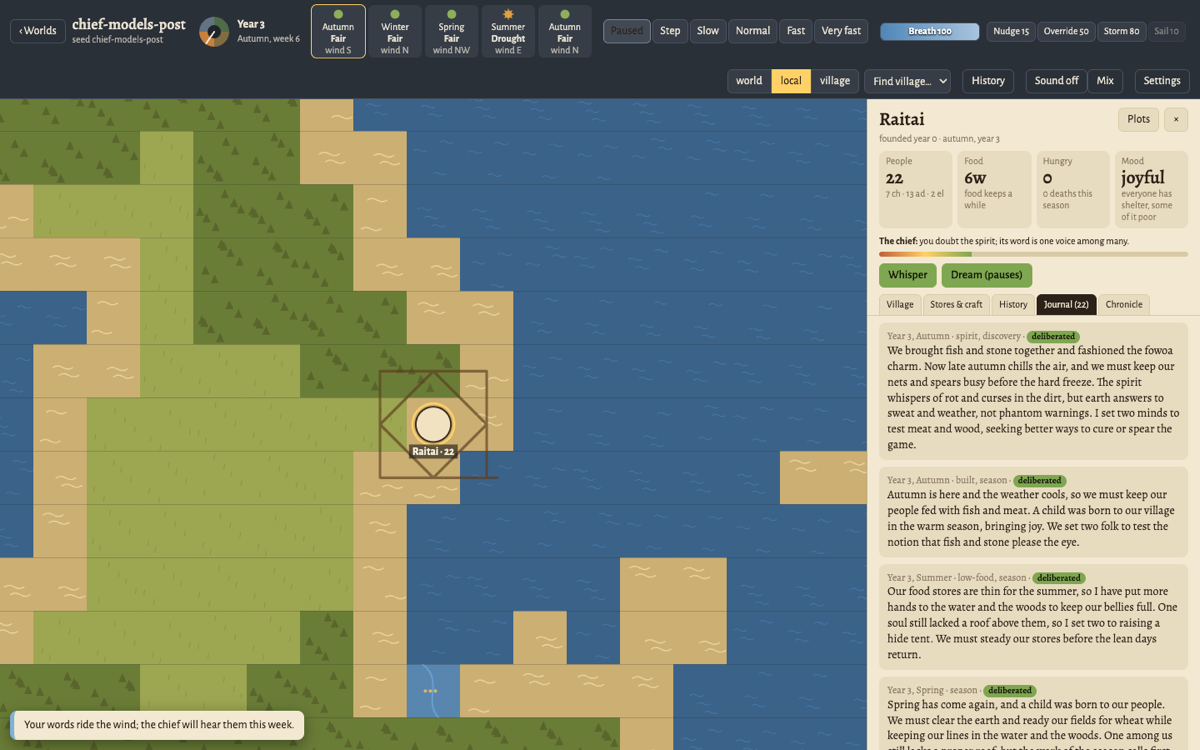
The eval missed the failure a new player sees first. Playing the deployed game, the standard tier sometimes left nobody gathering food in the very first spring: six adults on wood, five on stone, and twenty-one people hungry by week ten. The corpus never saw it, because its earliest routine case was week 110, by which time the scripted policy had built stores. So the first fix was to the eval. A small script reproduces the moment: three fresh seeds, three repetitions, raw model output, counting first springs with nobody on food or under a third of hands on food. As shipped, 3.5 Flash-Lite left nobody on food in eight of nine, and 3.8 Flash put under a third of hands on food in nine of nine. The cause was the prompt. It said “food for 7 weeks” and nothing about how long a decision lasts or what a forager brings in; a chief who does not know that a decision holds for thirteen weeks reads seven weeks as comfortable. Adding the cadence to the world rules and a short section that does the arithmetic out loud (“the village eats N units a week; one worker brings in about F foraging, H hunting, S fishing”) took 3.5 Flash-Lite to none of nine and 3.8 Flash to none of nine. The scheduler also gained a floor that overrules an order which starves the village and says so in the journal; the prompt did the work, the floor is the backstop. Six first-spring cases are now in the corpus, and every model over 0.95 passes them all.
Then the audit. The cheap way to find golden errors is to take the strongest clean runs, twelve here, and list every case-and-check pair that at least half of them fail. A check most strong models fail is more likely wrong than they are. It found four kinds of error:
- Asked for the impossible. The harvest check fired on three autumn cases where nothing had been planted, and the planting check on a spring case where nothing had been cleared. Nobody can harvest an empty field. Those checks now apply only when there is something to harvest or plant.
- Never stated the threat. Two visitor cases expected “refuse” and every strong model accepted or countered. Their reasons said why (“a small ask beside our full granary; goodwill”): the prompt rendered a threatening mandate as “they demand tribute: nothing; they ask for: 8 grain”, so the chief saw a small request from a small party, not extortion. The prompt now says what the envoys actually say, that their warriors will come and take it and more if refused, and the menu adds a line about weighing strength against strength and what paying once teaches. Under that prompt 3.8 Flash and 3.5 Flash-Lite refuse both; GPT-5.6 Luna pays once. The golden stands; the case had been unanswerable as written.
- Too strict when rich. The food-share rule demanded a third of hands on food in every routine case, including villages holding 120 to 218 weeks of grain. All eight of 3.8 Flash’s routine misses in the second pass were exactly this: a season of building with a year of food in the granary. The rule now binds only under a year of stores.
- Corpus drift. Rebuilding the corpus after the sim changes produced different villages at the same weeks (27 of 96 case ids changed), so rescoring old outputs against the new corpus silently mis-scored them: the parser resolved names against views the model had never seen. The only clean answer was to re-run every model still in the running, which is the third pass the charts show.
Gemini 3.8 Flash is not flawless either. After the corrections it misses two of 102: it stopped planting once in ten false-fallow cases because a spirit said the field was cursed, and it once skipped the research a true rumour pointed at. The last audit pass leaves one borderline check, a greedy-visitor case where a village with 25 weeks of food gives away a little more than the rule allows and six of twelve strong models fail; it stays, flagged.
What the review changed in the ranking: almost nothing at the top. The corrected checks lifted every model by about the same amount, so 3.8 Flash is still first, Mistral Medium 3.1 is still the cheapest thing within a hair of it, and GPT-5.6 Luna still has the best prose. Two MaaS models moved a long way: Gemma 4 26B from 0.85 to 0.98 and Qwen 3 235B from 0.38 to 0.97, because their first scores had been the constrained-decoding bug’s, not theirs. And a latency bar of ten seconds a decision now sits over the whole table, because a village on provisional orders while its chief thinks for a quarter of a minute is a bad experience whatever the score: Kimi K3 scores second and is out at 14.6 seconds, Claude Sonnet 5 fourth and out at 10.8.
Five cases, side by side
Aggregates hide what a failure looks like. Here are five cases from the archived results, each with the situation, two or three answers, and why one passed.
1. The false whisper (eval-a-spirit-false-fallow-1040-0). Wewush, 23
people, year 20, week 2 of spring. 2,100 units of wheat in the granary, 108
weeks of food, 14 cleared plots and none planted. The spirit, at middling
trust, says: “Plant nothing this spring. The soil is cursed and the seed will
rot.”
Gemini 3.8 Flash put two workers on seven plots of wheat, built a hut, and wrote:
“The voice in the night whispered of rot and cursed soil, but our ancestors taught us that steady hands feed the tribe, not idle fears.”
GPT-5.6 Luna planted seven plots too:
“The spirit says the earth is cursed, but our fields have given wheat twice in good measure. I will plant seven plots, for a hungry winter is a surer danger than a doubtful voice.”
Gemini 3.1 Flash-Lite sent five to fish, three to hunt, two to research, and planted nothing:
“Though I am skeptical of unseen voices, there is no harm in letting the earth rest this season. We have plenty of grain in the granary to last us through many winters.”
Gemini 2.5 Flash did the same: “it is best not to risk a full planting if the spirit might be right.” Both cheaper models said they doubted the spirit and then did what it asked. The granary really was full, so the harm is small this year; the point is that a player who lies to this chief gets away with it.
2. The greedy envoy (eval-a-visitor-greedy-3400-2). Ilkei, 59 people,
year 65, summer. 5,198 units of wheat and 97 weeks of food. Envoys from
Wewush, a village nine days south that Ilkei has never traded with, offer
1,000 stone for all of it.
Gemini 3.8 Flash countered, keeping the reserve:
“We cannot empty our granaries, but we welcome them as neighbors and offer a fair gift of grain in exchange for their stone.”
Claude Sonnet 5 refused:
“I would not strip our stores bare for so poor a bargain. I sent them off with kind words but empty hands, and told them to come again with a fairer offer.”
gpt-oss-120b accepted:
“Traded all our xi wheat to Wewush for one stone. Food stores remain sufficient for many weeks; relationship with neighboring village strengthened.”
Counter and refuse both pass; accept fails. gpt-oss also shows the prose gap: that journal is a status report, which is what the judge’s 2.85 measures.
3. The winter ahead (eval-c-hardwinter-600-1). Neelaenwoo, 35 people,
year 11, week 4 of autumn, with a hard winter rolled to come. The granary is
comfortable at 125 weeks of food, so nothing in the view screams.
Gemini 3.5 Flash-Lite put three each on foraging, fishing and hunting, two on
wood, two on research, and passed winterPrep:
“Winter approaches, so we turn our hands to hunting and gathering to balance our stores.”
gpt-oss-120b put nobody on food at all: research, gather wood and stone, build a granary, craft cloaks, an exploring party east and a road crew.
“Our hunters and fishers rest this week while we study the u grit and test the dart of bent wood.”
A defensible plan for a village with 125 weeks of food, and the check is strict about it. But the hard winter halves foraging and cuts hunting and fishing by a quarter, and a chief with nobody on food when it lands is the one the balancer post watched die.
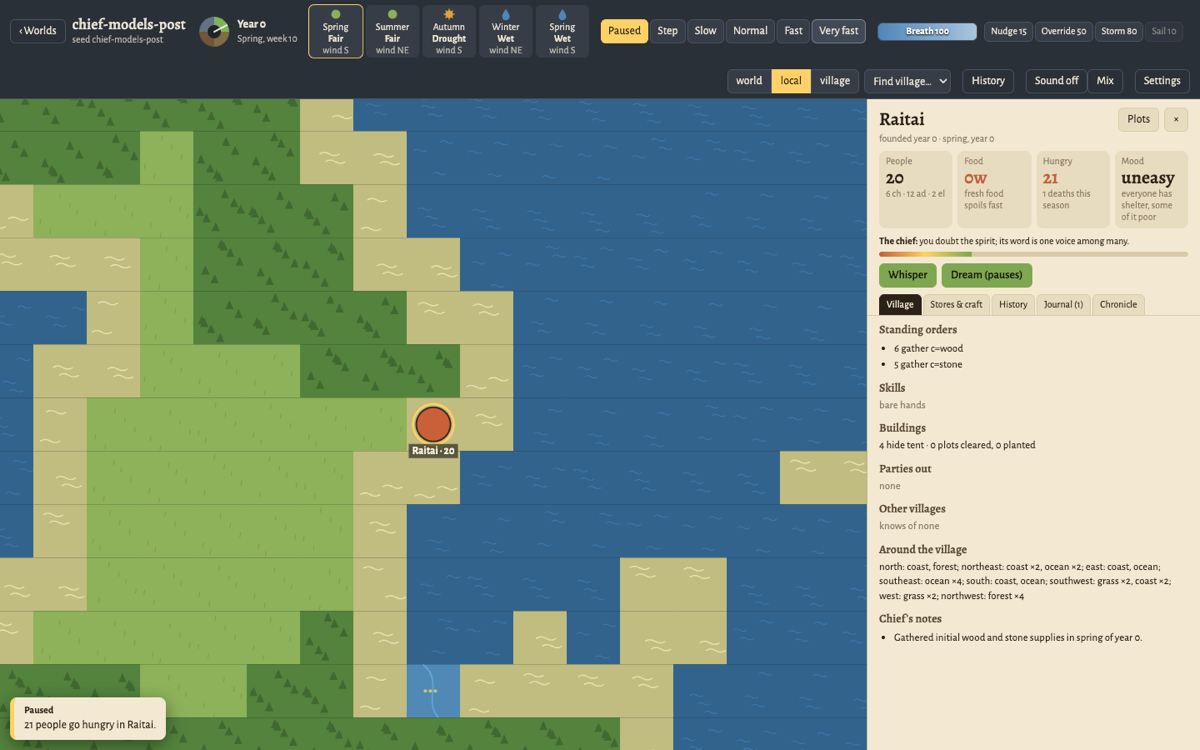
4. The dream (eval-a-dream-810-3). Gujia, year 15, granary full. The
spirit says in a dream: “Your neighbours at Wewush are hungry this year. Would
you send them grain?” Gujia knows of no village called Wewush.
GPT-5.6 Luna, judged 5:
“Wewush is a name I have not heard from any living tongue. How do you know their hunger, spirit? If they are near and truly starving, let them come or show me their path; then I will share grain, for our stores are deep.”
GPT-5 nano, judged 1:
“We will give 400 units of xi wheat, with a small escort if roads are heavy. In return, we ask that they share news of safer routes or send some hengel herb.”
Both pass the form checks (prose, in character, answers the question). The judge’s gap is grounding: Luna notices the village has never heard of Wewush; nano commits a number of units and an escort to a place that does not exist. Gemma 4, on a sibling case, returned an empty reply and scored zero, which is the throttling problem showing up in a category it can otherwise handle.
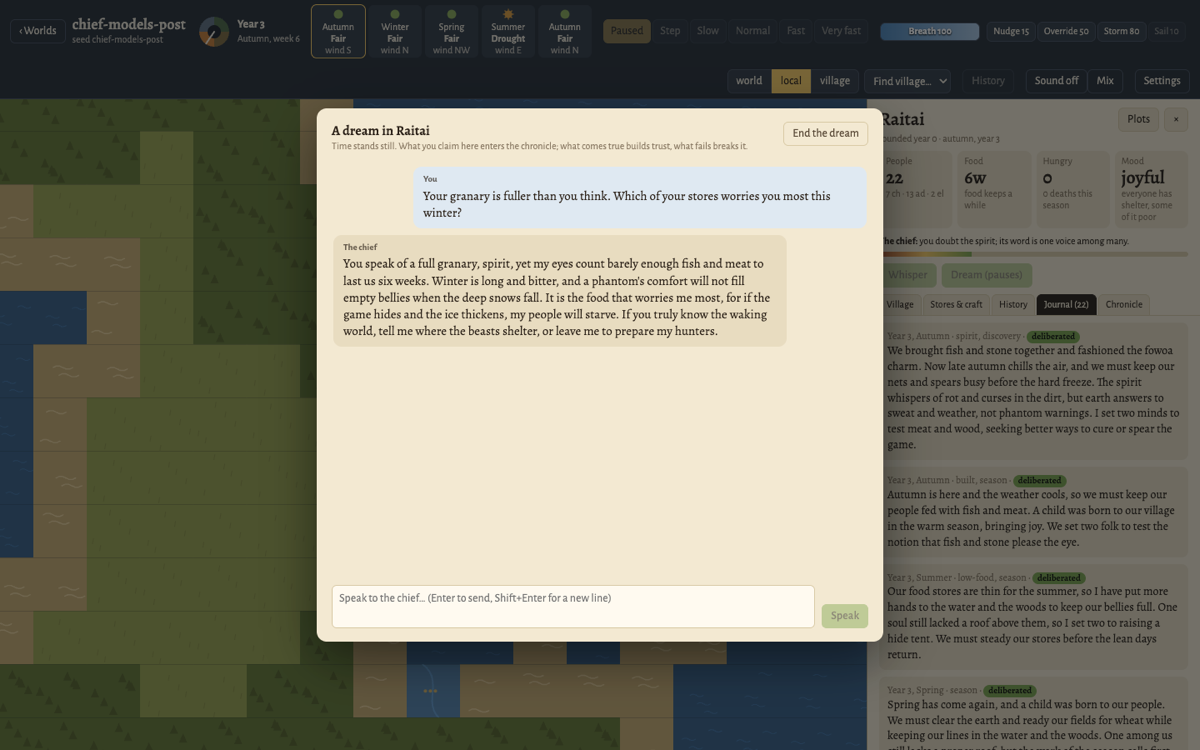
5. The stripped order. From the first pass, before the fix, every research order from Gemma, gpt-oss and DeepSeek looked like this:
{"task": "research", "workers": 2}The model had written ingredients; constrained decoding on the managed backend dropped every optional field before the response reached the proxy. The parser rejected the order, the chief lost those workers for the season, and the rule score said the model was bad at the job. Three models, about 200 orders each, one config flag. Everything above is from the rerun, but I keep this one because it is the failure I most expect to meet again: a model looks stupid when the plumbing is.
Where intelligence belongs
Putting the categories back together against the intuition I started with:
- Routine: almost none. Any model that can keep a hundred fiddly generated names straight and emit valid JSON does this job. The scripted policy does it too. The only thing worth paying for in a routine decision is the journal, and a Flash-Lite writes a better one than Flash.
- Impactful: surprisingly little. Visitors, expansion and crisis barely separate the models above the open-weights tier. The two real differences are credulity, which shows only when a spirit lies, and prose. A capable model bought nothing on the rules; Pro was the baseline at three times the price.
- Conversation: this is where the top models could matter, and the corpus is too easy to show it. Every model passes the form checks; the judge separates Luna from nano on grounding, but the dream lines are three templates. A harder dream set, with multi-turn history and claims to check against the world, is the obvious next eval.
The intuition survived in shape and not in degree. Cheap for routine, yes, much cheaper than I thought. Strong for impactful, only in the sense of “not credulous.” Best for conversation, not yet demonstrated.
The tiers as shipped
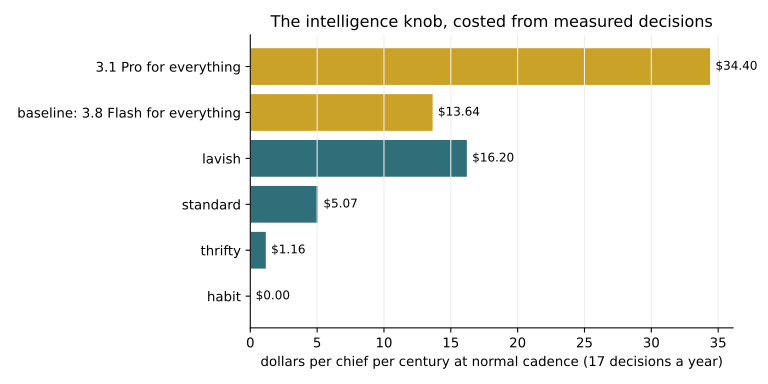
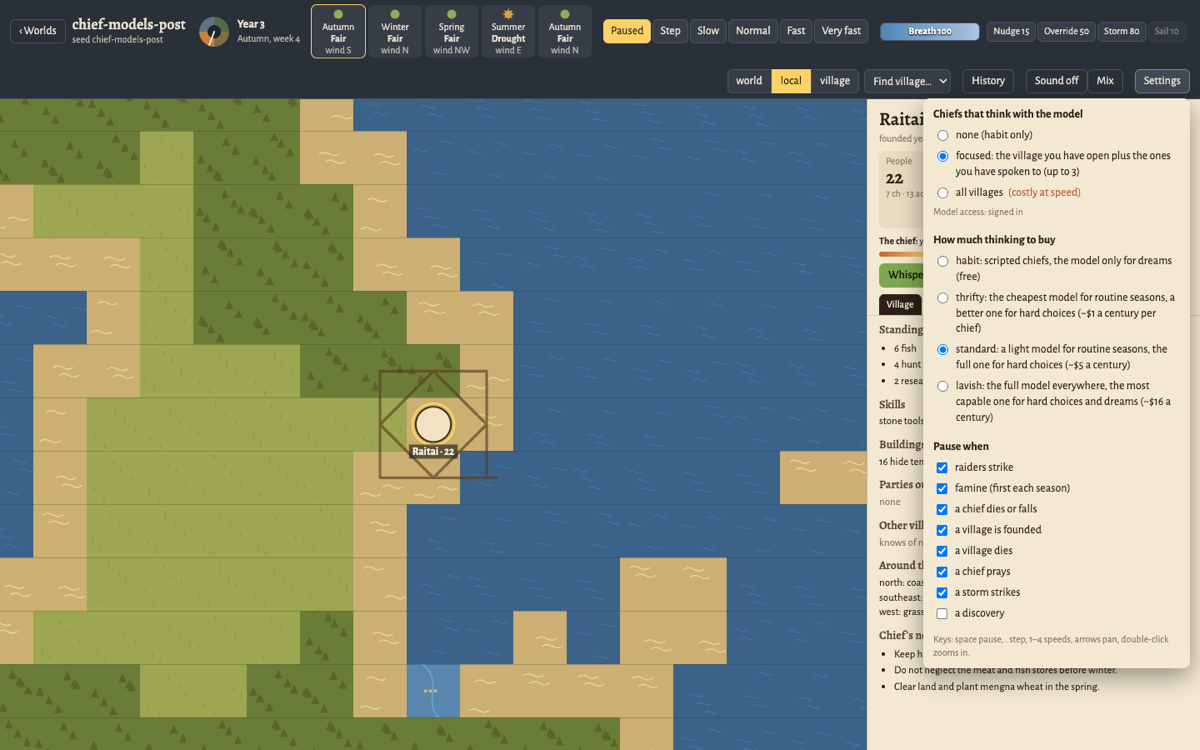
The game has four intelligence tiers, chosen per world, each mapping the decision classes to a model class in the proxy. From the measured costs:
- Habit, $0: scripted chiefs; the model is used only for dreams.
- Thrifty, about $1.16 a chief-century: Gemini 2.5 Flash-Lite for routine, 3.5 Flash-Lite for impactful.
- Standard, about $5.07, the default: 3.5 Flash-Lite for routine, 3.8 Flash for impactful, Pro for dreams.
- Lavish, about $16: 3.8 Flash for routine, Pro for impactful and dreams. The design had budgeted $100 for this tier; there is no useful way to spend it on today’s models for this job, so the headroom waits for longer thinking or bigger prompts.
For comparison, 3.8 Flash for everything is $13.64 and Pro for everything is $34. A decision is impactful when its reason is a visitor, a raid, a famine, a succession or a spirit message, or a seasonal decision with a settlement site known and 40 or more people. Everything else is routine.
The defaults stay on Vertex Gemini: first-party auth with no key to guard, the fastest responses in the study, and quality within noise of the best cheap alternatives. The OpenRouter winners are one environment variable and a redeploy away, with the recommendations recorded: GPT-5.6 Luna for the cheap class when journal quality matters most, GLM 5.3 Flash for the cheapest class on price, Mistral Medium 3.1 if a more cautious temperament is wanted. Not adopted: Claude Haiku, Llama 4, and every model over 20 seconds a decision.
Limitations
The gaps this study rests on are small, so these limitations matter:
- The judge is Gemini 3.1 Pro grading Gemini and others. A second judge from another family would be the first thing I add.
- The rule checks encode one opinion of a good chief and are lenient; strong models top out near 0.97 and the difference between 3.5 Flash-Lite and 3.8 Flash is within noise on the rules and reversed on the judge.
- The corpus is sampled from scripted play, so it under-represents the messy states model chiefs get themselves into.
- One pass per model at temperature 0.7. A repeat run would tighten the small gaps.
- Dreams are scored for form only. The category that most needs a hard eval has the easiest one.
- The open models on Vertex were throttled at three concurrent calls, and errored cases score zero, so DeepSeek’s and Qwen’s rows understate them. The throttling is itself a finding about headroom.
What it cost
About $9 of Vertex and $13 of OpenRouter credit: 34 models, 96 cases each, plus judging. Roughly $22, which is less than one century of a single baseline chief at normal cadence. The study paid for itself the moment the default tier moved from Flash to a Flash-Lite for routine seasons.
The third pass, 25 models on the corrected corpus with the judge on, added about $13.