Wind Spirit: balance is measured, not argued
Code: Wind Spirit
The idea
Wind Spirit is a civilization sandbox where every village is run by an AI chief and the player is a spirit who sees everything and can touch almost nothing. You win chiefs’ trust by whispering truths; they build the world with their hands.
It started as a long brain-dump. Villages with AI chiefs. Stone-age tech. A tech tree with made-up names so an LLM chief can’t just recall the real world and skip to bronze. Trade emerging from uneven resources, maybe violence, and the player as a spirit who can only talk to the chiefs. I handed that to Claude and we spent an evening organizing and critiquing it.
The reframing that made it a game came out of that session: the spirit is omniscient and impotent, the chief is ignorant and potent. A chief listens to the spirit because the spirit knows things. Advice that pans out builds trust, advice that fails erodes it, and trust is the scoreboard.
A lot of the rest fell out of that. A week tick, because my own arithmetic on walking speeds showed month ticks were too coarse. Paths that emerge from use and become roads. Boats and coasts. Provisioned versus foraging travel, so a desert is a real barrier. A scarce “breath” budget for wind and weather as the spirit’s one physical power. Event-sourced history so you can scrub back to any week. Generated music.
And one suggestion from Claude that I’m glad I took: before any UI or any LLM chief, build step zero, a headless balance harness with scripted chiefs, run for hundreds of years across many seeds. Every rate in the design was a guess. Balance is measured, not argued.
Why a balancer first
The concept document has a “balance ladder” in it. A village of about 20 should live easily on wild food. Around 50, wild food alone can’t sustain it, so farming has to start. Around 150, one tile’s farming isn’t enough without irrigation, husbandry or trade. That ladder pushes villages outward, and if the rates are wrong the game has no shape: either nobody ever needs to leave, or everybody starves in year ten.
Regrowth rates, yields per worker-week, spoilage, mortality curves, birth rates, hard-winter penalties, field fertility: all numbers I typed in because they felt about right. The Grammar Garden had already taught me that almost every constant I set by instinct was wrong by a factor of two or three. This design had fifty of them. So I had Claude build the sim first, with no screen, and drive it with scripted chiefs.
How the harness works
The sim is a pure, deterministic weekly tick in TypeScript: no clocks, no I/O, same seed gives the same world bit for bit. The harness wraps it with scripted chief policies that stand in for the LLM chiefs. A forager hunts, fishes and gathers and builds a granary at fifteen people. A farmer also clears plots and plants in spring. A sensible chief farms, explores, and sends colonists when its tile gets crowded. Three “legacy” policies and a set of parameter switches reproduce earlier, broken versions of the rules, so the failures stay reproducible after they are fixed.
A suite of eleven checks encodes the ladder: 20 people live for 100 years on wild food, 50 cannot, farming lifts a village past 50 but plateaus, sensible chiefs colonize and civilization persists 300 years, paths form. Plus determinism and replay checks. The suite runs in CI on six seeds.
The other tool is a weekly debug tracer for one village: population by life stage, orders, food produced against mouths to feed, stores, hunger, fields and fertility, deaths. Every failure below was diagnosed by reading that trace. Claude did the building and the tuning; my job was to look at the charts and say “that’s not a village, that’s a graveyard.” Getting the suite green took eight rounds. Four of the failures are worth reproducing here.
Collapse 1: a hard winter with no stores
The first forager villages didn’t build storage, and the first hard winter rule halved every food source at once. Combine that with the original starvation model, in which a few unlucky people starved outright while everyone else ate, and you get this.
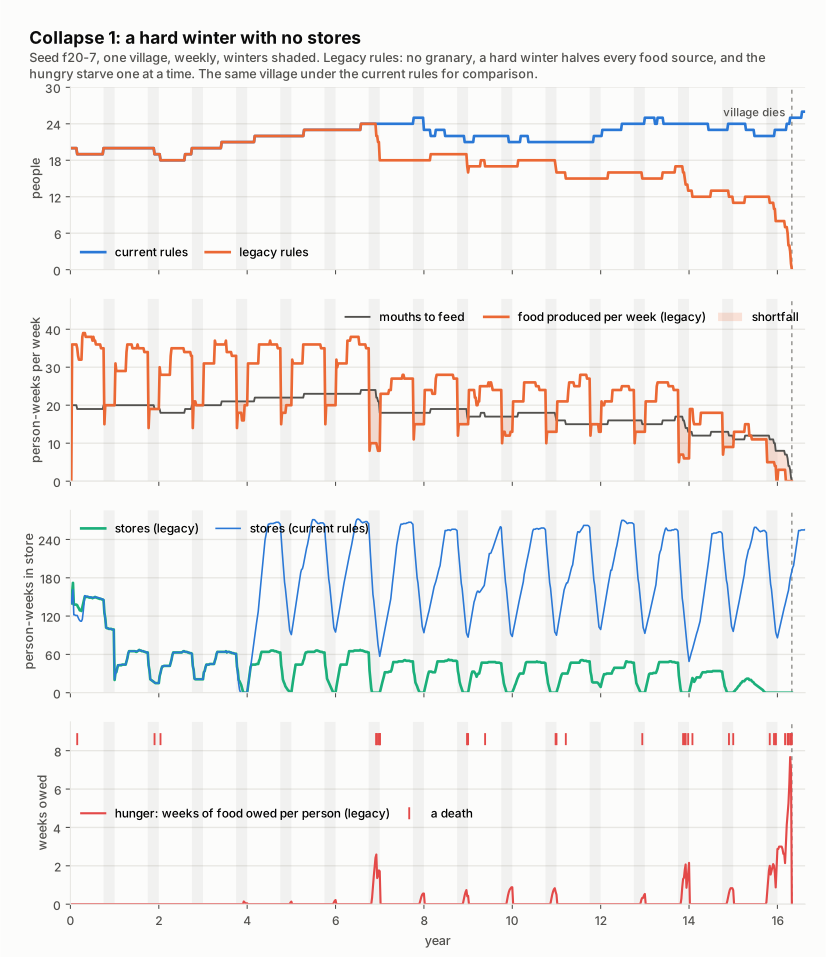
Look at the stores panel. Wild plants spoil in four weeks, meat and fish in two. Without a granary the village cannot carry summer into winter, so stores saw-tooth between 60 and zero and every spring is a small famine. The village loses a person or two most winters and drifts from 20 down to 12 over fifteen years. Then the winter of year 15 rolls “hard”: production drops to 5 person-weeks a week against 12 mouths, stores are already at zero, and the selective starvation rule kills the hungry one after another. Thirty weeks from the first death to the last. Under these rules 42% of villages made it to year 100. The same village under the current rules holds 25 people and banks 280 person-weeks every autumn.
Three fixes came out of this. The forager policy builds a granary at population 15. A hard winter halves foraging but only cuts hunting and fishing by a quarter, so a village with a spear and a net has something to eat. And starvation became rationing: everyone eats the same reduced share and hunger accumulates as a fraction of a week, so deaths still happen but the population gets time to respond.
Collapse 2: a chief that will not plant while hungry
The first farmer policy had a rule that sounded prudent: if the village is hungry in spring, keep everyone on food gathering and skip planting. It guarantees a famine in autumn.
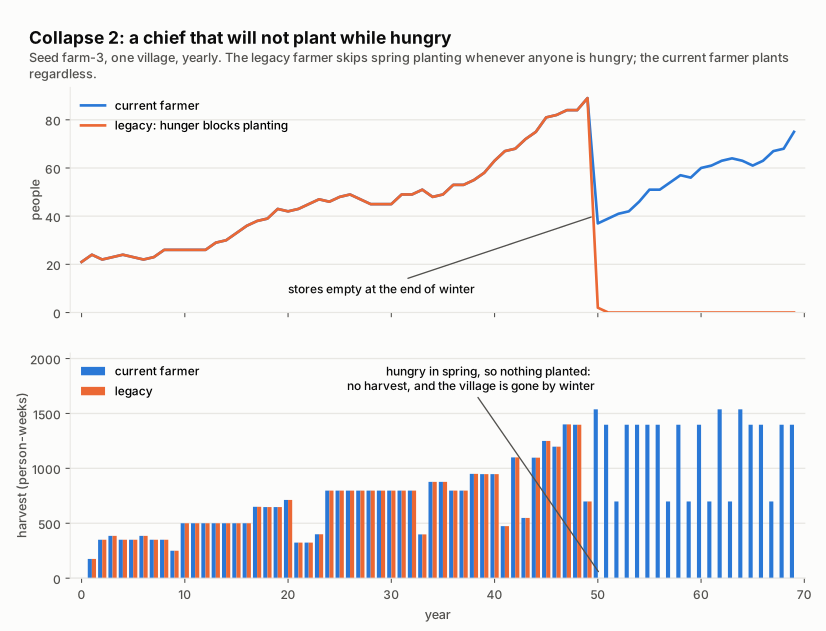
For 49 years the two runs are the same village. It grows to 88 people on 55 cleared plots, more than those plots can feed, and a poor harvest in year 49 means the stores hit zero in the last weeks of winter. Both chiefs start the spring of year 50 hungry.
The current farmer plants anyway. It loses half the village to the spring famine, which is horrible to watch in the weekly trace, but the harvest comes in and by year 70 it is back to 75 people. The legacy farmer keeps everyone foraging, fishing and hunting, produces about 60 person-weeks of food a week for 89 people, harvests nothing, and is gone before the year is out. Across 40 villages, 33 died under the hunger-block rule and 4 under the current farmer. Planting is the response to hunger, not something to postpone until you feel better.
Collapse 3: no plot cap, no rotation, no soil
A farm order runs every week of spring. Without a cap on how many plots to plant, the farmer plants every cleared plot every year. Each harvest drops a plot’s fertility by 0.15; a fallow season restores 0.05.
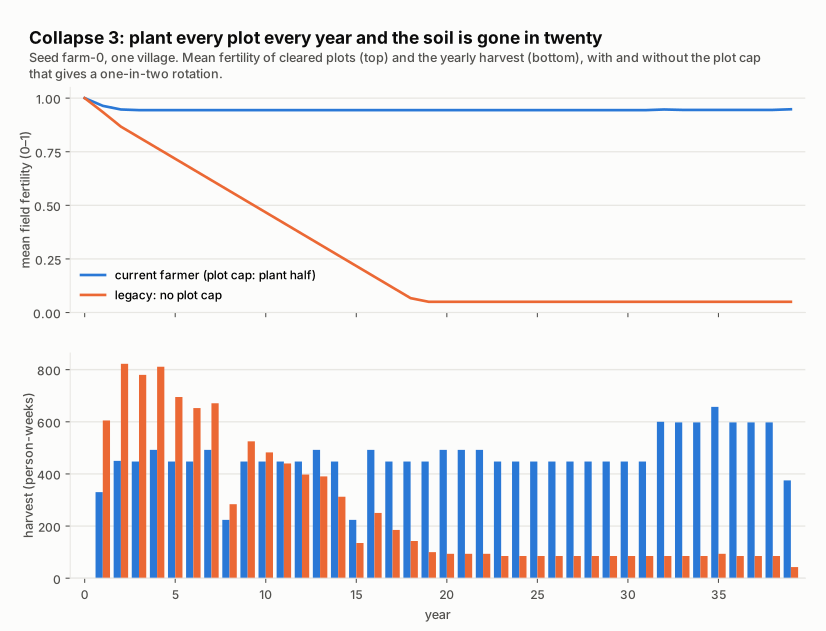
For the first eight years the no-cap farmer looks like the better chief: it harvests 800 person-weeks a year against 450. Then fertility crosses 0.5 around year 10, harvests fall below the capped farmer, and by year 19 the soil is at its floor and every harvest is about 90 person-weeks from 55 plots. It never recovers, because the policy never stops planting.
The fix: a farm order carries a plot count, the policy asks for half the cleared plots, and the sim plants the most fertile plots first. That gives a one-in-two rotation for free and fertility settles at 0.94. Nothing in the game tells a chief about fallow. A curious chief will notice rested plots recover, or the spirit will tell it. That is exactly the kind of knowledge the spirit is supposed to trade for trust.
Collapse 4: the demographic spiral
The slowest and hardest to see. Births were gated on “calm weeks”: any hunger at all reset the counter and stopped births. And adults worked from 15 to 55.
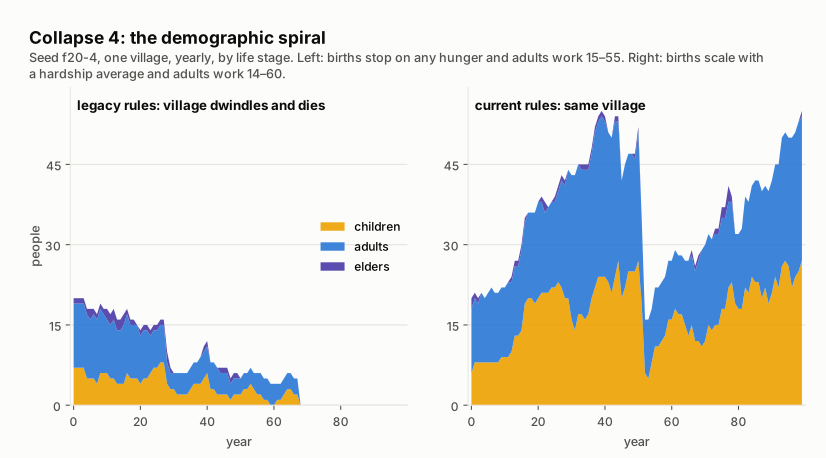
Mild winter hunger happened every year, so births ran below replacement every year. Meanwhile the short working life meant that by year 15 a typical village had sixteen children and four elders resting on nine adults. Four workers feeding ten people cannot bank a winter, which makes the hunger worse, which stops more births. The village in the chart takes 67 years to die and never looks dramatic in any single year.
The fix has two parts. Births now scale with a 25-week moving average of the shortfall and stop only when the village has been about 40% short on average: a smooth Malthusian regulator rather than a switch. And adulthood is 14 to 60. The age change alone moved forager survival from 78% to 93%, which surprised me more than anything else here.
The stages, one fix at a time
The legacy switches let me replay the tuning history as a single chart: forager villages of 20, 100 years, 40 villages per stage, adding one fix at a time in the order the lessons were learned.
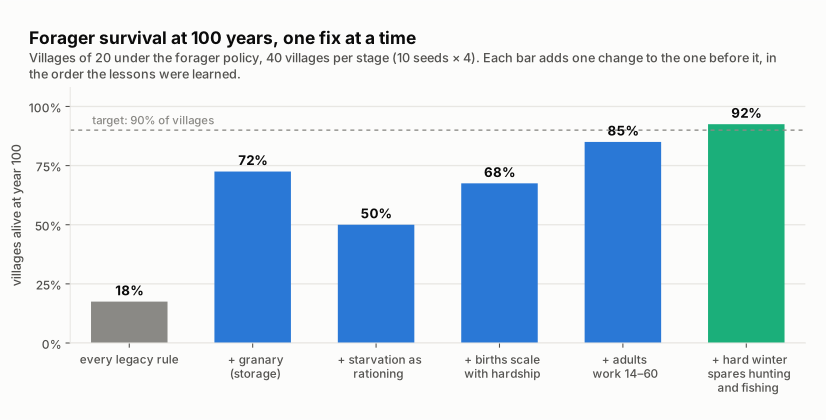
Two caveats. The “every legacy rule” bar is a reconstruction: the sim never actually ran with all five broken rules at once, so 18% is what the worst version would have done rather than what it did. And rationing on its own made things worse, 72% down to 50%. Sharing the shortfall meant everybody was a little hungry every winter, and the birth gate of the time stopped births on any hunger at all. The starvation fix exposed the birth model. That is the harness doing its job: a change that is obviously right in isolation had a side effect I would have argued about for an hour and been wrong.
The calibrated ladder
With all the fixes in, here is what the suite measures.
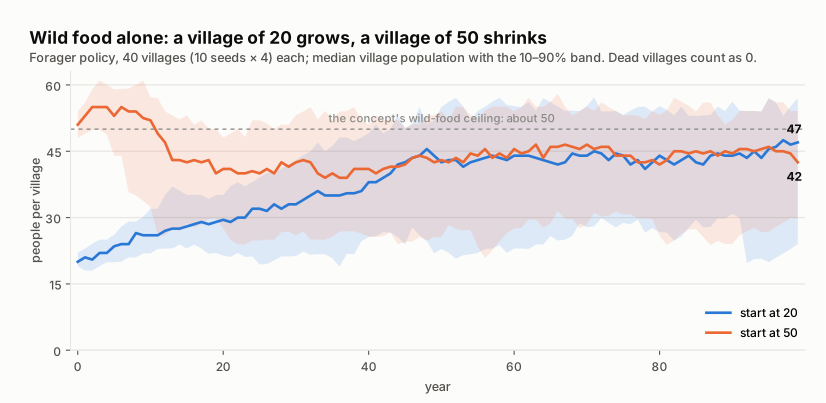
A village of 20 grows for forty years and settles around 45 to 50, the wild-food ceiling the concept asked for. A village of 50 loses a fifth of its people in fifteen years and sits at about 42. Both curves end in the same place, which is the point: on wild food the land, not the starting population, decides the size. 92% of villages of 20 survive the century.
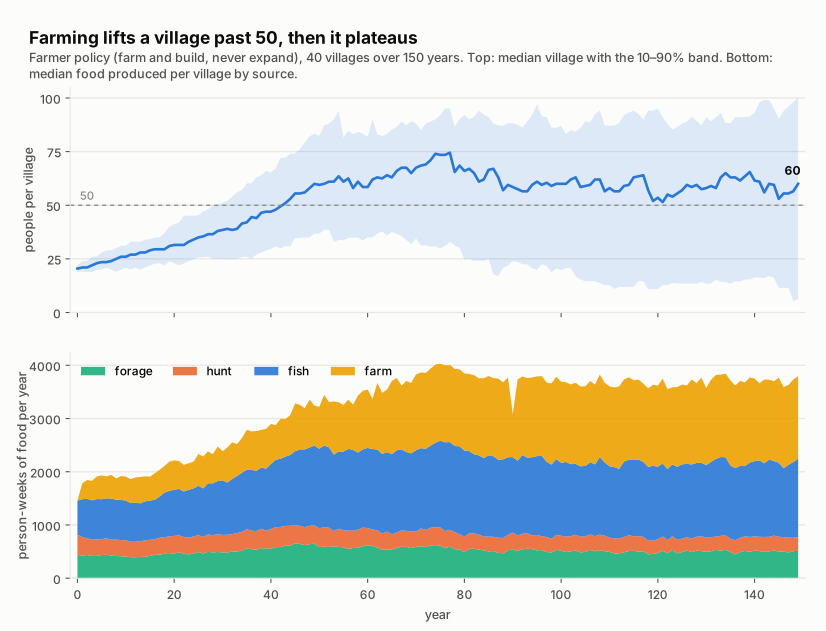
Farming lifts the median village to 60 or 70 and the best villages to about 110, then it stops, because one tile has only so many plots and the policy does not know about irrigation yet. Wild food stays flat at about 2,000 person-weeks a year while the fields add 1,500 on top. Hunger is 46% of deaths, which is high on purpose: a village that cannot expand is supposed to feel the ceiling.
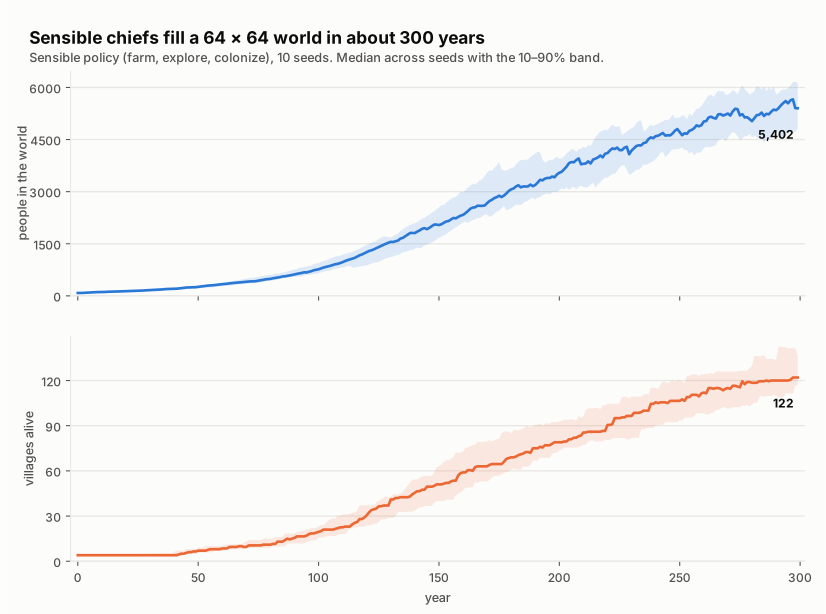
Sensible chiefs colonize. The first colony lands at a median of year 43, and by year 300 a 64 by 64 world has about 120 living villages and 5,400 people, with 700 to 950 tiles of path worn between them. Every seed persists. Growth is about 1.3% a year, and the flattening at the end is the map filling up. That is the intended pressure, and it says larger worlds or slower growth will matter once the map is on a screen.
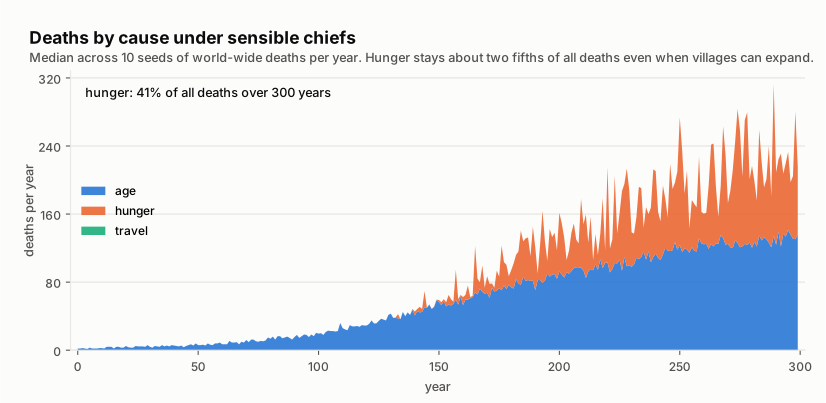
Even with room to expand, hunger is 41% of deaths. The spikes are hard winters and droughts hitting many villages at once. I’m fine with that for now: the spirit sees the weather four seasons ahead, and those spikes are the moments where a whispered warning is worth trust.
What the balancer taught me about the game
None of this is new to anyone who has built an ecological model, but I had to learn each one from a trace of a village dying.
- Storage is the first survival technology. Fresh food cannot build stores. Summer surplus is wasted and every winter is a shortfall until something slows spoilage. The granary is the difference between 42% and 72% survival.
- Starvation is rationing, not selection. Killing the unlucky few while everyone else eats produces cliffs. Sharing the shortfall produces slopes, and slopes give a chief time to act.
- Births regulate before deaths do. A birth gate that trips on any hunger shrinks a population for decades without anyone noticing. A regulator tied to average hardship gives a Malthusian curve instead of a spiral.
- Working life sets the ceiling. The ratio of workers to mouths is the most sensitive number in the sim. Six years of adult life moved survival by fifteen points.
- Farming needs rotation. Without a plot cap the soil is gone in twenty years and nobody notices until the harvest is a tenth of what it was. Chiefs will need to learn this or be told, and being told is the game.
- Never let hunger block planting. The prudent-sounding rule is the fatal one. Planting is the response to hunger.
One more, about the process: the sim pushed back on almost every rule I wrote, and the failures were legible. I would not have found the demographic spiral by watching a map, because nothing dramatic happens in any single year.
What’s next
The harness is now the sim’s permanent regression test; it runs on every commit. On top of it, in order: the tech tree generator with its obfuscated names and hints, so villages have something to discover; the LLM chief, which gets the same view the scripted policies get, including expected yield per food source each season; and then, finally, a screen.
I expect the LLM chiefs to find new ways to collapse that the scripted policies never did. When they do, the trace will be waiting.