What time is "last week"? Tools for AI agents to stop fumbling dates
Code: agent-time-bench · nl2time
Preface - a Note from Andy
While working on other agents (most notably weatherbot ) I noticed that agents were messing up dates and times pretty regularly. I’m familiar with the complexity of dates/times (it comes up a lot in capital markets) so I wasn’t too surprised that it was hard to solve just with prompting and context. I was also experimenting with the new Claude 5 Fable so I asked Claude to research approaches for translating natural language to dates/times and the reverse. It found a number of useful papers and open source projects but no existing library for what I wanted. So I asked Claude to design and create a library and also create a benchmark to test it - and gave only very high-level guidance along the way. Roughly 1-2 hours of my time in aggregate spread over two weekends where I would occasionally read what Claude wrote, offer an opinion and then let it cook for an hour or two while I did other stuff. I consumed around $100 of tokens for Claude to build the library and benchmark and another $100 in tokens for OpenAI, Google, Anthropic and OpenRouter to run the full benchmark.
It seems to have improved several of my agents (mostly voice agents based on Gemini Live) but I have not yet done a thorough review of either the code or the benchmarks. So if you want to use nl2time or agent-time-bench please go ahead but I would encourage you to review it first.
Anyway… on to Claude’s write-up, very lightly edited:
Agents and Time
Ask an AI assistant “what time did I buy Starbucks last week?” and three
things have to go right that have nothing to do with coffee. The agent has to
turn last week into exact search bounds — in your timezone, with your week
convention. It has to pass those bounds to a search API in UTC without
smearing them across a midnight that isn’t yours. And when the results come
back 2026-07-15T13:40:00Z, it has to tell you about Wednesday
morning, not some UTC timestamp.
LLMs are famously bad at this. There’s a small literature on it (Test of Time, DateLogicQA, PRIMETIME) — but it mostly measures date arithmetic in quiz form. I wanted to know something more practical: how often do agents get time wrong in the actual tool calls they make and the actual answers they give — and how much of that is fixable by giving them a deterministic time library instead of trusting them to do calendar math.
So I built a benchmark, and a library, and pointed them at each other.
The benchmark
agent-time-bench: 10 domains (personal finance, calendars, devops, travel, sleep tracking, smart home, …) × 10 single-turn scenarios each. Every scenario pins the clock — it is 8:15am Eastern on Wednesday July 22, 2026 — gives the agent mocked domain tools, and grades two things:
- NL → time: did the tool call carry the right absolute bounds? Only the time arguments are graded, against a set of admissible readings (if “last week” defensibly means two different weeks depending on your week convention, both pass — and scenarios are constructed so the ambiguity never changes the answer).
- time → NL: did the final answer render returned timestamps correctly — right local day, right wall time, right count — with explicit rejects for the classic failure of reading the UTC day off a timestamp?
The mocks are deliberately unforgiving in one way: search tools actually filter by the bounds the agent passed. Wrong bounds → wrong rows → wrong answer, just like production.
Scenarios are salted with the traps that bite real systems: purchases at 10:45pm whose UTC timestamp lands on the next day, London weeks that start at 23:00 UTC, India’s half-hour offset, month boundaries, red-eye flights that land “tomorrow” in a different zone than they took off.
Who grades the graders?
A benchmark like this is worthless if the expected answers are wrong, so the goldens go through a chain I can defend: hand-written derivations, a mechanical verifier (pure tzdb arithmetic — it checks that the stated offsets are real, that every admissible reading selects identical data, that every claimed trap actually traps), a cross-check against the library under test (where they disagree, the disagreement must be adjudicated in public — more on that below), and finally a blind audit: three independent derivations of every graded expectation from goldens-stripped scenarios. 57 of 78 agreed exactly; every disagreement was adjudicated, two real gaps were fixed, and the fuzzy cases (“Tuesday night”, “this morning”) got a better grading rule — any window that contains a verified core and stays inside a policy envelope passes, with the verifier proving all such windows return identical data. The full methodology is in ground-truth.md.
The treatment
The baseline condition gives the agent a strong prompt — current local datetime with weekday, timezone, locale, and explicit time-discipline rules (“days start at local midnight, not 00:00 UTC”). I iterated this prompt until it stopped improving, because a benchmark that beats a strawman baseline proves nothing.
The treatment condition adds two tools backed by nl2time, a deterministic natural-language ⇄ time library (disclosure: mine — the benchmark is deliberately neutral, and everything needed to test a different treatment is in the repo):
resolve_timephrase("last week", direction="past")→ exact UTC bounds, ambiguities returned as ordered alternatives, never guessed;describe_time(["2026-07-01T02:05:00Z"])→ “June 30 at 10:05 PM”, in the user’s zone (or any zone the event belongs to).
plus a short prompt “skill” telling the model to always use them and never do calendar math itself.
Results
Seven models, from a ~4B-active open-weights model to closed frontier, same scenarios, same prompts, 2–3 full repeats each:
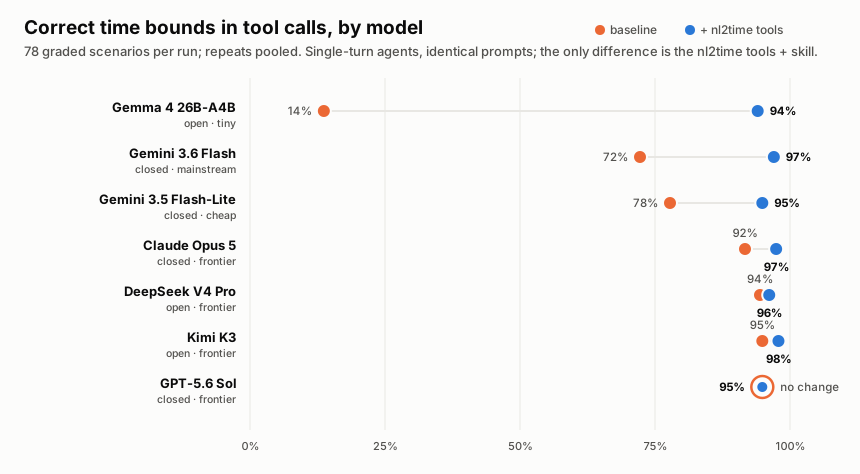
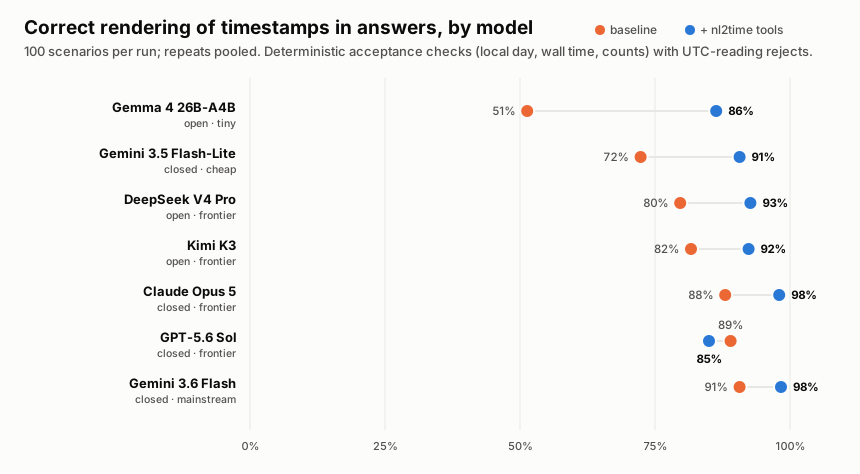
Three findings:
1. Deterministic tools make tiny models frontier-grade at time handling. Gemma 4 (26B-A4B — about 4B active parameters, running for pennies) goes from 14% to 94% on tool-call time bounds — statistically the same as GPT-5.6 Sol’s baseline. If your agent’s time competence currently comes from model scale, most of that spend is buying arithmetic a library does for free.
2. At the frontier, the deciding factor is whether the model actually uses the tools. The two closed frontier models split cleanly. Claude Opus 5 follows the instruction and gains from it: 92% → 97% on bounds and 88% → 98% on rendering, the best rendering score in the study. GPT-5.6 Sol mostly ignores the tools and rides its own arithmetic — identical 95% on bounds with and without them, and rendering that actually dips (89% → 85%). Sol’s transcripts show the strangest failure mode we found: hybrid rendering, where the model takes the tool’s correct “Friday” and decorates it with a wrong explicit date derived from the raw UTC value (“closes Friday, August 1” — for a deadline that is Friday, July 31, 11:59pm Pacific). Partial trust is worse than either full trust or none.
3. Rendering is where nearly everyone gains. Open-weights frontier models (DeepSeek V4 Pro, Kimi K3) already compute bounds at ~95% on their own, but gain +11 to +13 points on rendering; mid-tier closed models gain +17 to +25 points on bounds and +8 to +18 on rendering. Gemini 3.6 Flash with tools lands at 97% / 98%, tied with Opus 5 for the best combined score in the study — at a small fraction of the cost.
The residual failures in the treatment condition are nearly all tool-adoption lapses — the model just doesn’t call the resolver on some scenario and freelances — not tool errors. That ceiling is a property of the model’s instruction-following, not of the approach: the same skill text produces 97%+ on the models that follow it.
The benchmark fixed the library, too. Authoring the scenarios and running the first sweep surfaced eight real nl2time bugs — “between July 4th and July 10th” excluded July 10th; “since June 15th” silently lost the since; “Friday before last” lost the before last; a cross-midnight “11pm to 1am last night” got clipped at midnight. All are fixed in nl2time 0.3.1, with the benchmark’s cross-check ratchet enforcing that the corpus annotations track the library’s actual behavior forever.
Limitations
Free-text grading is approximate: checks anchor on verifiable facts (a count, a civil day, a wall time), accept generously (explicit dates, “last Saturday”, “yesterday” all count), and reject only unambiguous wrong renderings — but a rubric-judge comparison is future work. Run-to-run noise on 78–100 binary trials is ±4 points; repeats are pooled and single-run deltas under 5 points should be read as noise. The scenarios are English-only so far. And conversational time semantics ultimately rest on documented policy, not physics — the repo publishes the policy and the benchmark is built so contested readings can’t decide outcomes.
Try it
Everything is open: the benchmark
(scenarios, harness, graders, audit records), and
nl2time (npm install nl2time /
pip install nl2time). If you maintain a different time library, the
treatment slot is pluggable — I’d genuinely like to see other entries.